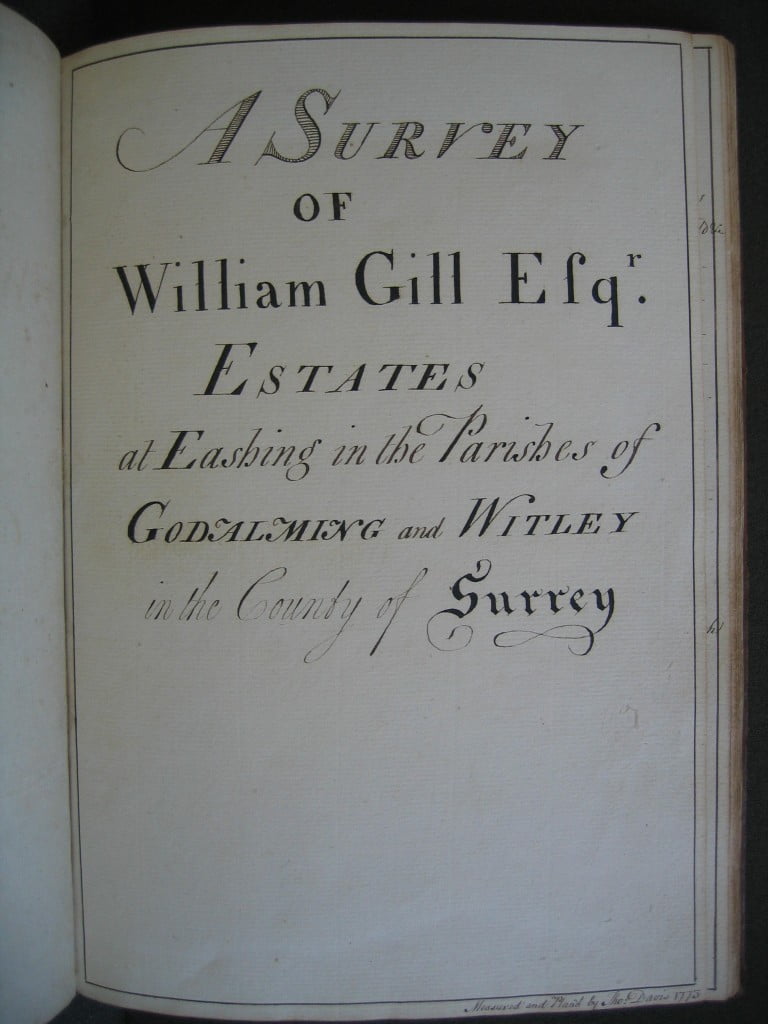
Ezra Gill, of Quaker stock, started buying the estate land in the early 1720s and built Eashing House between 1729 and 1736 on the site of the house then known as Jordans. His sons William Gill and Henry Streeter Gill made extensive further acquisitions and by 1800 their property included virtually the whole of the hamlet of Eashing and extended into Elstead, Witley, Godalming and Wonersh. Ezra’s grand-daughter Mary married James Henry Frankland in December 1810. He assumed the name of Gill and the estate passed to him.
This record was made by Ezra’s son William and is a facsimile copy of the complete survey of the Gill Estates in 1773, complete with detailed plans of several local properties. William and his brother Henry owned many properties in Eashing, such as The Stag, which he sold to John Sharp, also of Eashing, for £150 in 1771.
Each page links to a full-size, readable version with description of where it is.
The maps are as follows:
1. Mansion House [Eashing House] and 5 fields
2. Mansion House [just N of Eashing House] and 5 fields
3. Farmhouse and 2 houses and 4 fields at Upper Eashing
4. 7 fields south of Town Lane
5. 4 fields between Town Lane and Aaron’s Lane
6. House in Town Lane [Halfway House] and 11 fields N to River Wey
7. 6 fields N of Town Lane
8. 10 fields S of bend of River Wey near Hurtmore
9. 2 houses at Upper Eashing and 7 fields
10. Cottage beside road near Eashing House and 7 fields
11. 6 fields at Lower Eashing
12. 5 fields on either side of Oxenford Lane
13. House, 11 fields and engine house, by Eashing bridge
14. 6 fields at Norney, between Peper Harow Park and Lower Eashing
15. 5 fields at Norney, N of last plan
16. An acre strip and other parts of Light Field, N of Lower Eashing, and inclosed lanes
17. House S of Eashing Bridge, and cottage and fields N of it
18. House and 6 fields at Norney
19. 6 fields near Shackleford Heath
20. Smith’s Place at Lower Eashing, an ozier bed and 3 fields
21. 4 fields at Ockford, late General Oglethorpe’s
22. 3 fields, allotments in Shackleford Heath


